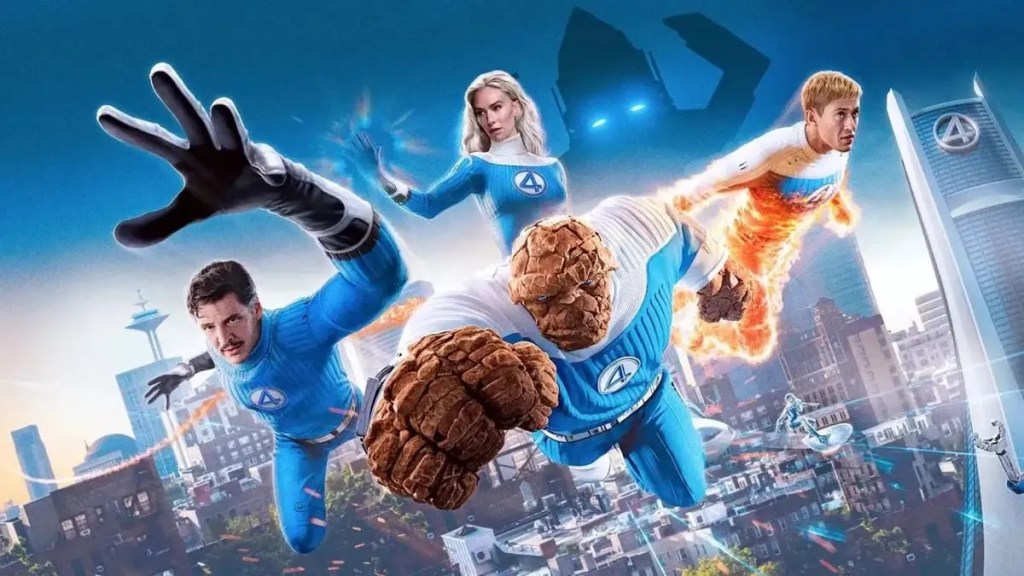
Those who know me well, know how much the MCU movies have left a bad taste in my mouth. Aside from a few exceptions, namely Ryan Coogler’s soulful Black Panther outings and Taika Waititi’s wildly entertaining and ludicrousity-embracing Thor: Ragnarok, a lot of whatever Marvel Studios produces for the big screen leaves me wanting much less than more. The entire franchise is preoccupied primarily with cinematic extensionism, expanding its “universe” for expansion’s sake and often sooner than later. If this is all it wants, I hope for its heat death.
But then I saw Pedro Pascal cast as Reed Richards in the trailer for The Fantastic Four: First Steps, and my heart filled with hope, or at least with a modicum of good will, knowing the cinematic gift he is. And so I went, bracing for the familiar. Hoping for the new. Dear readers, it’s a mixed bag.
Like James Gunn’s Superman released a few weeks ago, FF:FS largely avoids the typical superhero origin story route (as it should with no less than three preexisting versions, each one per preceding decade). It lands us in a parallel Earth (828) within a projection of a early 1960s United States with all of its idealism and none of its social and historical frictions that were boiling underneath the surface of that momentous decade.
This world is a united one. And in a somewhat disquieting way, unquestioning and dutiful in its bowing to the whims of a USA, with its foes (e.g. Mole Man) in defeat and its threats under surveilance. We see this mid-century mid-Atlanticism awash in its Googie prosperity, which may very well have been Jack Kirby’s milieu and inspiration. But seeing it realised in today’s Trumpian reality can feel both escapist and wistful. Maybe even poignant and depressing.
Is this all a conscious political statement or genuine evocation of the source material? I will merely say that there is a deep space shot of the Fantastic Four’s Excelsior (probably with a nod to Kubrick) with the spacecraft’s engraved words “United States,” but with first part hidden in shadow. I think Disha of CounterCurrents.org describes it best when the film presents America, “Not as it was, but as it wishes to remember itself.”
Thinking about all this thoughtful imagery feels compelling in retrospect. But it didn’t really sink in for me while watching the movie. The film’s rich production value somehow feels muted and less vibrant than it should (or perhaps Mad Men just feels more evocative for me). The choice to project this vision through its quaint JFK New Frontier lens, renders it mundane and earthbound. It pales in its unavoidable comparison to Brad Bird’s The Incredibles (the best Fantastic Four movie to this day), which was able to convey the vibrancy and joie de vivre of the same era with more exuberance, depth and style. Unshackled by the constraints of the live-action format and unbound by canon, Brad Bird could plumb the ideas of a “nuclear family”as well poke fun at superhero conventions in ways that the MCU might never be able to.
As for the film’s story, there really isn’t much there in its retelling of the well-known canon of Galactus’s earthly arrival. Director Matt Shakman seems keenly aware of this and tries a few things to keep things fresh, and some of them I admired.
As Matt Zoller Seitz helpfully points out, Matt Shakman’s strengths are in characterisation, and it shows. I felt for Pedro Pascal’s version of Mr. Fantastic; Earth 828’s most intelligent scientist, fearless in his scientific and strategic calculations, yet fearful in his personal and social expression. I was happy to see Ben Grimm portrayed by Ebon Moss-Bachrach as a sensitive yet accutely intelligent near-equal to his best friend Reed, going against the well known “big lug” persona that has long been associated with the Thing.
I was pleasantly surprised to see the playboy persona of Johnny Storm, played by Joseph Quinn, tampered down in favor of his ingenuity and resourcefulness. His character has key moments in discovering human insights from his adversaries and key strategies to face them, often on his own and without supervision. Gone is the brainless blonde hunk that he was long known for. And in Vanessa Kirby, we truly have the most powerful and emotionally resonant of the four finally portrayed as she should have been in the past. She does a lot of the heavy lifting in eliciting our sympathy, particularly in a speech that might not have worked in the hands of a lesser actor. I thought it was also a blast to finally see the might of a pregnant superhero, which I don’t think I’ve ever seen before.
More important than the individuality of these characters are their interactions, which feel as genuine as can be despite the artificiality of the world which they exist in. I hesitate to deem them “authentic” since they have moments few and far between that border on being out of a sitcom (the dealing with the baby schtick gets old). Any interactions with characters outside of their circle are less convincing and more shallow, such as Ben Grimm’s romantic inclinations for Rachel Rozman (played by Natasha Lyonne), which goes nowhere. That said, this cast does an admirable job of being warm, believable and interesting despite it all.
And as for H.E.R.B.I.E, he’s a poor man’s Wall-E.
The film has other attractions. It was neat seeing Galactus finally envisioned as Jack Kirby probably would have. I have long wondered why he should take a humanoid form (Yes, I know it’s been explained why). Alas, he kind of explains it himself in the movie. The entire sequence where the FF travel to and escape from Galactus’s planet-devouring ship, especially the light-bending spectacle of wormhole traveling, was new and quite thrilling. Let it be said that the visualisation of black holes have forever been changed due to Christopher Nolan’s Interstellar, as evidenced here and in Gunn’s Superman.
I liked how Julia Garner played the Silver Surfer as a maternal figure near the end of the film, but not as much as a romantic figure (that was pushing it). I must say that silver-coated characters haven’t much improved visually since Robert Patrick’s T-1000. I guess there’s something about liquid metal that does no favors cinematically.
Another quibble if I may: I think it would have been more interesting to see Sue Storm and the Surfer help resolve the climactic Galactus finale as two figures using their shared maternal histories, than Johnny Storm helping solve the puzzle of her origins. But that’s just me.
Despite all the things that I liked about the movie, my feelings continue to oscillate around half-recommending this movie to others. Galactus’s arrival is a treat to finally see, but feels entirely on autopilot once it gets going. Baby Franklin Richards is a heart-melter, but becomes a plot device and eventual story crutch than a kid you really care for (I hope he wasn’t an AI special effect, but I wouldn’t be surprised if he was). The entire cosmic conflict is appealing to longtime afficionados who’ve long waited to see it, but for more adult-minded concerns, it’s a short thrill that in the end feels pretty impersonal and distant.
What kind of disappoints me above all is, as what my good friend Seongyong Cho has told me, “What a safe product it is.” It is thoughtful in many ways, but it doesn’t really say all that much, nor push its boundaries to enthrall us emotionally and thematically in ways that say Gunn’s Superman does in spades.
And yet, that might be enough if you’re looking for a simple good time at the movies. Simple being the key word. I dunno. Ask me again later.

 The Flipcritic
Leave a comment